Home › Services
Board and farm fence: plank, rail and wire for Bluegrass acreage
Drive any road out of Lexington toward Versailles, Paris or Georgetown and the long runs of plank fence climbing over the rolling pasture are part of the view. Plenty of homeowners on a few acres want that same look along their own frontage, or need something practical to keep a couple of horses, goats or a dog where they belong. Board and farm fencing covers a wide range, from a painted four-board fence along a driveway to a woven wire pasture fence with a single plank on top to a high-tensile run around a hayfield. This page is written for homeowners on country lots and small acreage, not large commercial farms. It covers materials, post spacing and depth, which side the boards belong on, wire choices, gates wide enough for a tractor, how rock and hills change the job, and the painting and upkeep that board fence asks for.
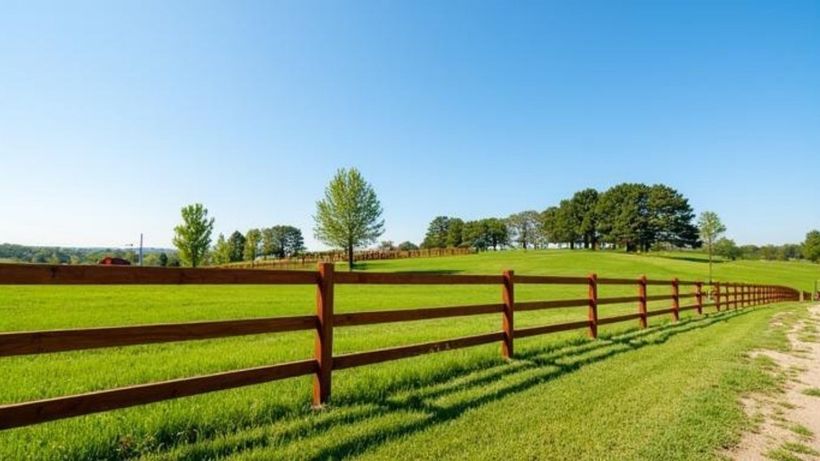
The four-board plank fence and its cousins
The classic local look is three or four horizontal boards nailed or screwed to wooden posts, usually painted black or white. Black has become common on many properties because scuffs and weathering show less, while white gives a crisp, traditional outline that stands out against green grass. Both are simply paint or stain choices over the same basic structure, so the decision is mostly about appearance and how often you want to recoat.
Variations include three-board fences for a lighter look and lower material count, the crossbuck or X-pattern used as a decorative accent near the house, and post-and-rail fences where split or milled rails slip into mortised posts with no fasteners at all. Some owners run a plank fence along the road for appearance and switch to wire for the back pastures where nobody sees it. That mix keeps the visible part handsome while holding down the total cost.
- Four-board: the most familiar form, good for horses and for road frontage.
- Three-board: a lighter look, suited to lawns and borders rather than livestock.
- Crossbuck: X-braced sections, mostly decorative near entrances and houses.
- Post-and-rail: rails set into mortised posts, easy to assemble and to replace piece by piece.
Oak boards or treated pine: what each gives you
Rough-sawn oak has long been used for plank fencing in Kentucky. It is dense, strong and hard for a horse to break, and it holds paint reasonably well once it has dried out. It is also heavy, can twist or cup as it seasons, and is not naturally resistant to rot where it touches the ground, which is why boards are kept above grade. Oak boards are often hung green and allowed to season on the fence before they get a first coat.
Pressure-treated pine is lighter, straighter and resists rot and insects, which makes it popular for posts and increasingly for boards as well. It is softer than oak, so a horse that likes to chew or lean may do more damage. Treated posts should be rated for ground contact. Many fences combine the two, with treated posts and oak boards, and the proposal should state which species goes where and what treatment rating the posts carry.
Post spacing, depth and setting in rock and clay
Plank fence posts are commonly spaced around eight feet on center so a sixteen-foot board spans two bays and joints can be staggered from row to row. Staggering the joints keeps a weak line from running straight down the fence. Some builders tighten spacing on hilly ground or where livestock push hard. Corner and end posts carry the most strain and are usually larger in diameter and set deeper than line posts.
Posts may be set in concrete, in tamped gravel or driven with a hydraulic post driver, and each has its defenders. Driven posts compact the soil around them and can be very solid in the right ground, but a driver will not go through limestone. Around Lexington, rock often sits within a few feet of the surface, so an installer should probe the line and plan for an auger with a rock bit or a pinned footing where needed. Tamped gravel drains better than concrete in wet clay, which helps wooden posts last. Whatever the method, ask for the depth and backfill to be written down.
Which side the boards go on when animals are inside
If you keep horses or other livestock, the boards belong on the animal side of the posts. When a horse leans, rubs or pushes on the fence, the boards press against the posts rather than pulling the nails or screws straight out. Boards mounted on the outside look tidy from the road but can pop loose under pressure, leaving a gap an animal can work through.
Where the fence is purely decorative, such as along a front lawn, boards are often placed on the road side for the cleaner look. On a property with pasture on one side and a yard on the other, the builder should ask which side matters more. Top boards are sometimes capped with a flat board or protected with a strand of electric wire offset on standoffs to discourage chewing and leaning.
Woven wire, welded mesh and high-tensile for pasture
Board fence is attractive, but it is not the only choice for pasture. Woven wire, sometimes called field fence or no-climb when the openings are small, is stretched between braced corners and stapled to line posts. No-climb mesh with narrow openings is favored for horses because hooves are less likely to slip through. Wider field fence works for cattle and is common on hay ground. A single board along the top improves visibility for horses and gives the fence a finished look.
High-tensile smooth wire is another option for larger areas. Several strands are strung tight, held by in-line strainers and anchored to heavily braced end assemblies. It is economical over long distances, can be electrified, and flexes when an animal hits it instead of snapping. It does depend entirely on strong corners, so the H-braces or angle braces at every end and turn are the most important part of the job.
- No-climb woven wire: small openings, good for horses, goats and dogs.
- Field fence: larger openings, typical for cattle and general pasture.
- High-tensile: several tight strands, often electrified, needs strong braced corners.
- Board top or offset hot wire: added to wire fences for visibility and to stop leaning.
Gates wide enough for a tractor, a trailer or a mower
Walk the property with the machines you use in mind before settling on gate locations. A lawn tractor fits through a much narrower opening than a compact tractor with a bush hog or a truck pulling a horse trailer. Many owners choose gates of twelve feet or more for field access and a narrower walk gate near the barn or house. Turning radius matters too; a gate at the end of a narrow lane may need to be wider than the machine itself.
Wide gates put a big load on the hinge post, so that post should be larger and set deeper than a line post, and many builders add a brace or a cable to keep the gate from sagging. Metal tube gates are common for field openings, while wooden gates built to match the board fence look better near the road. Ask about latches that can be worked from horseback or from a tractor seat, and about which direction each gate swings on sloped ground.
Building on rolling ground and around rock outcrops
Bluegrass pasture rarely stays flat for long. On rolling land, board fences are usually built to follow the contour, with boards running parallel to the ground rather than stepped. That keeps the gap under the bottom board consistent so animals cannot slip under at the dips. In low spots, posts may need to be tied down to keep a tight wire fence from lifting them out of the ground, and dips that carry runoff may need a water gap or swinging panel.
Rock outcrops and shallow limestone along creeks and hillsides can force posts off the ideal line. A builder may shorten spacing, anchor into rock, or route the fence slightly to reach better ground. Near the Kentucky River and its tributaries, steep banks and floodplain ground call for extra care, and it is wise to check with the county before building close to a stream.
Painting, staining and keeping a board fence up
A painted plank fence is a commitment. Sun, rain and freeze-thaw cycles break down any finish, and most board fences need a fresh coat every few years to stay sharp. Black fence coatings made for farm use are often asphalt- or oil-based and soak into rough-sawn boards; white fences usually use exterior latex. Spraying is faster over long runs, while brushing works finish into rough lumber better. Ask whether the first coat is included, and when it should go on if the boards are green.
Beyond paint, expect to walk the fence a few times a year. Look for loose or cracked boards, nails backing out, posts rotting at ground level and wire losing tension. Replacing a single board early is far easier than rebuilding a section after a horse has broken through. Keeping weeds and brush trimmed along the fence line also helps the wood dry out and makes problems easier to spot.
- Walk the line in spring and fall and after big storms.
- Refasten loose boards and replace cracked ones before animals find them.
- Check corner braces and retighten wire as needed.
- Recoat paint or stain before the old finish fails completely.
What to ask for in a board or farm fence proposal
Farm fencing is often priced by the foot, but the details inside that figure vary widely from one builder to the next. A clear proposal makes it possible to compare apples to apples.
- Total footage, fence type, height and number of boards or wire strands.
- Species and treatment of posts and boards, with post diameter and length.
- Post spacing, setting method and depth, and how corners and ends are braced.
- Which side boards are mounted on, and whether joints are staggered.
- Gate sizes, material, hinge post details and latches.
- How rock, brush clearing and old fence removal are handled and priced.
- Whether painting is included, the product used and the number of coats.
Board and farm fence — common questions
Should my board fence be painted black or white?
It comes down to looks and upkeep. Black tends to hide weathering, mildew and scuffs longer, so it can go a bit longer between coats and still look tidy from the road. White gives a bright, classic outline but shows dirt and peeling sooner. Both are finishes over the same fence, so choose the look you like, then check any HOA rules and ask the contractor which coating they plan to use.
Is oak or treated pine better for a four-board fence?
Oak boards are strong, dense and hard for horses to break, but heavy and prone to some twisting as they season. Treated pine is lighter, straighter and resists rot, yet it is softer and easier to chew. Many fences use treated posts with oak boards to get the best of both. The right answer depends on whether you keep animals and how much maintenance you want to take on.
How far apart should posts be on a plank fence?
Eight feet on center is a common spacing because standard sixteen-foot boards span two bays and let joints be staggered between rows. Builders often tighten that on steep or rocky ground, near gates, or where livestock lean on the fence. Corner, end and gate posts are usually heavier and set deeper than line posts. The spacing and depth should be written into the proposal before work starts.
What kind of fence keeps horses safe on a small property?
Horse owners commonly choose board fencing with the boards on the inside, no-climb woven wire with small openings, or a combination with a board along the top for visibility. Barbed wire is generally avoided for horses. Whatever you choose, the fence should be tall enough, highly visible and free of gaps where a hoof or head can get caught. Talk through your animals with the contractor before settling on a design.
How wide should a gate be for my tractor?
Measure your widest piece of equipment, including mowers or implements, then add room to maneuver. Many owners choose gates of twelve feet or wider for field access, and wider still if a truck and trailer need to turn in from a narrow lane. The hinge post for a wide gate must be heavy and deeply set, and a brace or cable helps keep the gate from sagging over time.
How often does a board fence need repainting?
It depends on the coating, the wood and how much sun the fence gets, but many board fences need a fresh coat every few years to stay looking sharp. Rough-sawn boards soak up the first coat heavily, and green oak should season before it is painted. Watch for fading and bare wood on the south-facing side first, and recoat before the old finish fails completely.
Can a contractor build a fence on hilly, rocky ground?
Yes, but it takes more planning. On rolling land the boards usually follow the slope so the gap underneath stays even. Where limestone is close to the surface, the installer may use a rock auger, pin posts into rock, adjust spacing or route the fence slightly. Low spots that carry water may need a swinging panel or water gap. Expect rock and steep terrain to add time and cost.
Talk through your site
Start with the address, what you want done, and a few photographs of the area, including anywhere water sits after a heavy rain.
Related work
Fence Installation
New residential fences laid out and set for Bluegrass clay, limestone and rolling lots.
Fence Repair
Heaved or leaning posts, dragging gates, storm and tree damage, and when to start over.
Wood Privacy Fences
Privacy fences in treated pine or cedar, built to handle wind, sun and wet springs.
Vinyl Fences
Vinyl privacy, picket and post-and-rail fences that stay clean with little upkeep.
Aluminum Fences
Ornamental aluminum for front yards, pools and sloped lots.
Across the metro
Nicholasville
Fast-growing Jessamine County subdivisions south of Lexington.
Georgetown
Scott County neighborhoods and larger lots north of Lexington.
Versailles
Woodford County homes, small farms and board-fence country to the west.
Winchester
Clark County town lots and rural properties east of Lexington.